
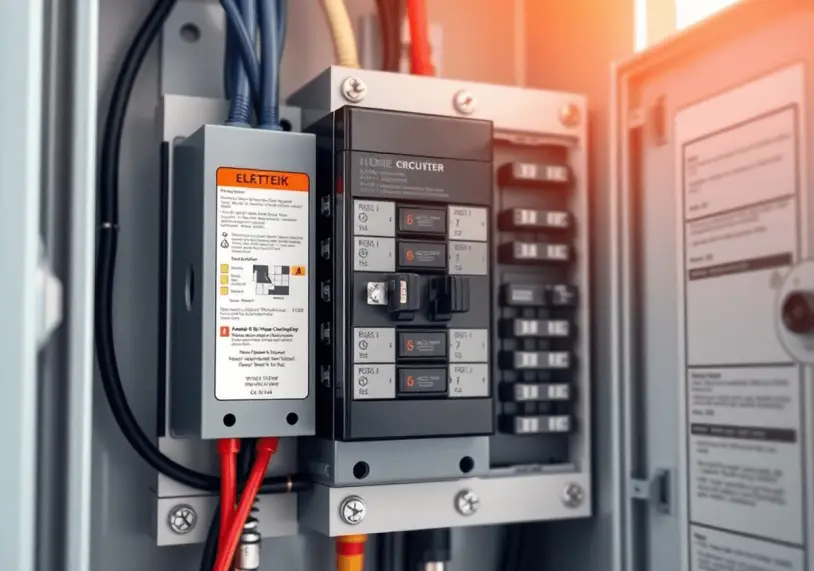
If you run an industrial or commercial electrical connection, you’ve probably heard your electricity board mention “power factor” — usually right before a penalty charge shows up on the bill. Here’s what it actually means, and why fixing it is one of the more cost-effective upgrades a facility can make.
What Power Factor Actually Is
Power factor is the ratio between real power (the power that actually does useful work — running motors, lighting, machinery) and apparent power (the total power your system draws from the supply, including the part that gets wasted). A power factor of 1.0 would mean every unit of power drawn is being put to use. In practice, most industrial setups with heavy motor loads run somewhere between 0.7 and 0.85 unless corrected — and electricity boards charge a penalty once it drops below a set threshold, usually 0.9.
What a Low Power Factor Actually Costs You
A poor power factor doesn’t just mean a penalty line item. It also means:
- Higher current draw for the same amount of useful work, which heats up cables and transformers faster than they should
- Reduced effective capacity of your existing electrical infrastructure — you’re paying to move power that never does anything useful
- More frequent equipment strain, particularly on motors and transformers running near their rated load
On a factory floor running multiple large motors, this adds up fast — and it’s one of the more overlooked line items on an industrial electricity bill.
How a Power Factor Improvement Panel Fixes It
- A Power Factor Improvement Panel (PFI panel) uses capacitor banks to supply reactive power locally, right at the point where it’s needed, instead of drawing it all the way from the grid. This brings your effective power factor closer to 1.0, which:
- Removes or reduces the utility penalty
- Frees up capacity in your existing transformer and cabling — sometimes enough to delay or avoid an expensive infrastructure upgrade
- Reduces line losses across the facility
Most panels use automatic power factor correction (APFC) — the panel monitors load in real time and switches capacitor stages in or out automatically, so it stays optimized as load changes through the day rather than being tuned for one fixed condition.
What This Looks Like on Site
We’ve installed and maintained PFI panels across several industrial sites where motor load makes power factor correction worth the investment — plant expansions, new production lines, and retrofits on older facilities that were never corrected in the first place. The panel sizing depends entirely on your actual load profile, which is why this isn’t really a product you buy off a shelf — it needs to be sized against your site’s specific equipment and usage pattern.
If your last few electricity bills have a power factor penalty line you’ve been ignoring, it’s worth getting the load profile checked before assuming a bigger connection or transformer upgrade is the only fix.

Leave A Comment